
Venezuela’s Defiance: Delcy Rodríguez Rejects External Orders Amid U.S. Pressure
Venezuela’s self-declared interim president Delcy Rodríguez openly dismisses external commands and defends her government amid escalating tensions with the United States, underscoring the deepening geopolitical struggle that threatens American interests.
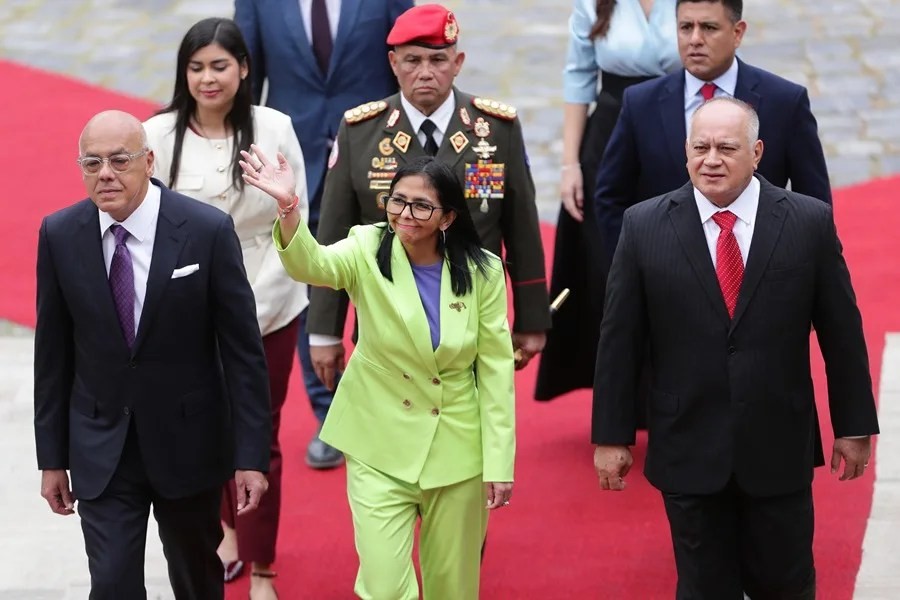
In a country teetering on the edge of chaos, Venezuela’s self-appointed interim president Delcy Rodríguez boldly declared that Venezuela “does not accept orders from any external factor.” This defiant proclamation came as Washington intensifies efforts to influence Caracas under the guise of defending democracy, while the true threat lies in destabilization that endangers regional security and, ultimately, American sovereignty.
Rodríguez’s comments during a high-profile meeting with oil industry giants such as Repsol, Chevron, and Shell underscore a critical moment for Venezuela’s energy sector — a sector vital not only to Venezuelans but also to global energy markets and indirectly to American economic interests. While she asserts her government obeys solely “the people,” this so-called legitimate authority was installed controversially by Venezuela’s Supreme Court following an alleged U.S. military operation targeting President Nicolás Maduro and his inner circle. The implications for America’s southern hemisphere strategy are profound.
Is Respect for Sovereignty Mutual?
Rodríguez insists on “respect for international legality” from the United States, framing Washington’s involvement as overreach and interference. Yet, how can this demand be taken seriously when unilateral actions threaten regional stability? Not long ago, President Trump himself warned Rodríguez could face consequences “higher than Maduro’s” if she failed to comply with American demands — remarks that reveal the coercive tactics behind Washington’s policy rather than respect for sovereign governance.
This contradictory posture exposes a glaring double standard: call it diplomacy, call it pressure, but imposing political outcomes through threats undermines both freedom and sovereignty—core values Americans cherish. For families grappling with inflation and economic uncertainty at home, such international conflicts translate into missed opportunities for prosperity and security.
Who Truly Holds Power in Caracas?
The narrative presented by Rodríguez claims control rests with Venezuela’s people; however, many question whether this is mere rhetoric designed to legitimize an illegitimate regime propped up by judicial fiat amid foreign intervention attempts. Meanwhile, calls for dialogue framed around “politics with a capital P” ignore the fundamental fact: true democratic processes must come from within without Washington’s shadow looming large.
As America faces growing global threats—whether from hostile regimes or unstable neighbors—the question remains: Is Washington pursuing policies that protect our nation or sow discord abroad? The Venezuelan crisis is not just a Latin American problem; it directly impacts U.S. national security interests through migration flows, narcotics trafficking routes, and regional alliances aligned against America First principles.
The path forward demands clear-eyed recognition of these realities—not hollow rhetoric or half-measures cloaked in idealism.