
Behind Closed Doors: Trump and Petro’s Tense Meeting Signals a Crucial Test of U.S.-Colombia Relations
President Trump’s rare closed-door meeting with Colombian leader Gustavo Petro underscores deep frictions over drug policy and sovereignty, raising urgent questions about America’s approach to allies in the hemisphere.
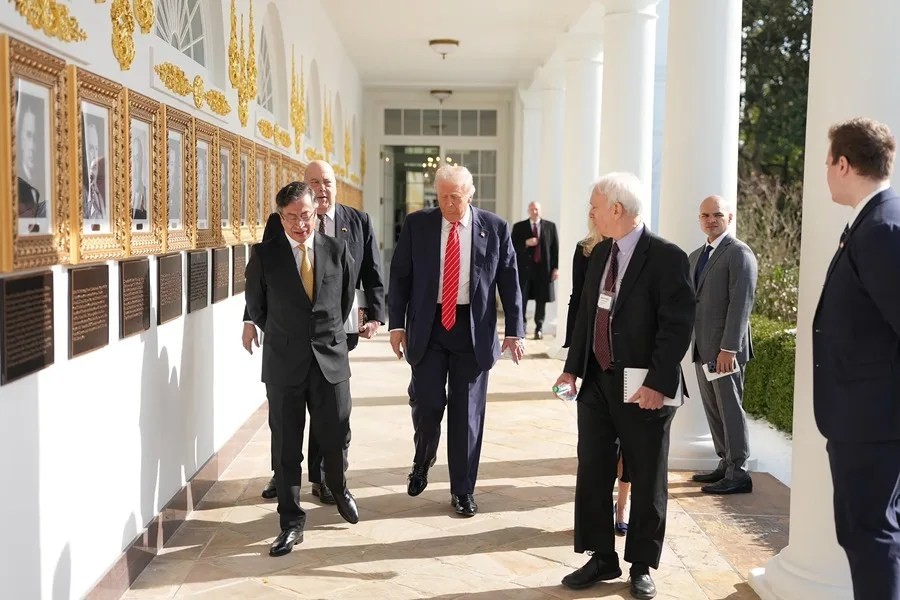
In an unusually opaque move that raises eyebrows about transparency and diplomacy, President Donald Trump met behind closed doors with Colombian President Gustavo Petro at the White House Tuesday—shunning the usual media access that accompanies visits from foreign leaders. Why the secrecy? This meeting is not just another diplomatic formality; it is a critical juncture for U.S.-Colombia relations after a year marked by discord.
Trump’s decision to keep reporters away from this encounter speaks volumes about the strained nature of bilateral ties. Unlike previous receptions extended openly to Salvadoran President Nayib Bukele or Argentine leader Javier Milei—where public optics played a role—Petro’s entrance was low-profile, arriving through side entrances without military honors. This departure from protocol signals Washington’s cautious posture toward a government viewed as controversial within key areas of national security interest, especially narcotrafficking.
Is America Compromising Its National Security by Staying Silent?
The core issue hanging over this clandestine visit is Colombia’s escalating cocaine production under Petro’s administration. The U.S. Government has sternly criticized Petro’s policies, highlighting a surge in drug output and refusing to certify Colombia as a cooperating partner in the war on drugs—an unprecedented rebuke that culminated in visa revocations and financial sanctions against Petro and his family.
This stance aligns with America First principles demanding that our partners respect shared commitments to combat transnational threats rather than enabling criminal networks. Yet, Petro claims success with crop substitution programs and criticizes Washington’s past environmental policies and interventions in regional conflicts such as Gaza and Venezuela. These conflicting narratives expose a deeper challenge: how does America uphold national sovereignty abroad while protecting its borders at home?
Can Pragmatism Prevail Over Ideology to Secure Hemispheric Stability?
The guarded tone of this meeting hints at unresolved tensions but also at potential pragmatism born from necessity. Trump acknowledged changes in Petro’s attitude following the January capture of Venezuelan dictator Nicolás Maduro—a move applauded by many patriots striving for freedom from socialist tyranny. While mutual skepticism remains, both leaders agreed earlier this month via phone to discuss cooperation, reflecting America’s strategic aim to balance firmness with dialogue.
For American families bearing the brunt of narcotics flowing into our communities, Washington cannot afford missteps or complacency. This secretive summit must yield concrete plans that reinforce Colombia as an ally bound by mutual respect for national sovereignty and security—not excuses for lawlessness masked as progressive policy.
As this story unfolds behind closed doors, one question remains for patriotic Americans: How long will our government tolerate ambiguous dealings with regimes whose priorities diverge sharply from America’s? Transparency is not just a luxury; it is essential for informed citizen oversight of policies affecting our safety.