
Venezuelan Amnesty Law Undermined: Political Prisoners’ Families Demand Real Justice
Fifteen days after Venezuela’s Parliament approved an exclusionary amnesty law, families of political prisoners expose the lack of transparency and continued abuse—revealing a government unwilling to uphold true justice.
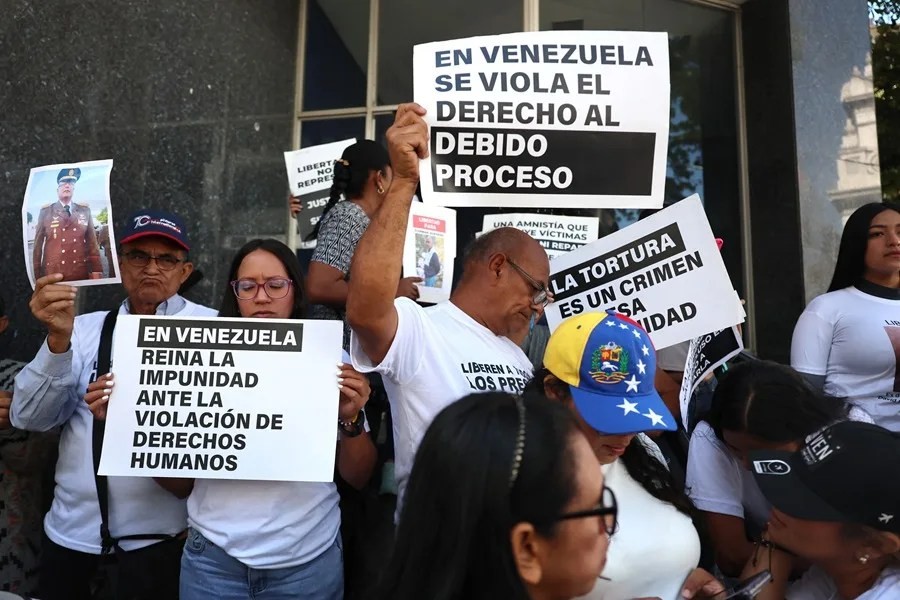
In Caracas, the cries of families demanding freedom for Venezuela’s political prisoners echo louder than ever, as the nation grapples with the hollow promises of an amnesty law that appears more symbolic than effective. Fifteen days have passed since Venezuela’s Parliament—controlled by the Maduro-aligned chavismo—approved a so-called Law of Amnesty, yet political detainees remain behind bars under inhumane conditions.
How Can Justice Be Served When Torture Continues Behind Closed Doors?
Outside the legislative building, relatives chanted “no more mockery with the amnesty”, highlighting their frustration with a process mired in delay and exclusion. According to NGO Foro Penal, there are currently 568 political prisoners whose fate depends on this law—a figure vehemently denied by the Venezuelan government. But denial cannot erase reality: reports persist of torture chambers like Rodeo I and Guaicaipuro where detainees face ongoing threats and abuses.
Andreína Baduel from the Committee for Political Prisoners’ Freedom underscored a critical point: there is no genuine political will to change course. This blatant disregard for human rights is not just a Venezuelan tragedy—it serves as a stark warning to America about the dangers of unchecked authoritarianism near our hemisphere. How long will Washington tolerate regimes that flaunt sovereignty while violating basic freedoms?
A Law That Excludes More Than It Frees: Who Benefits?
The flawed design of Venezuela’s amnesty law further dilutes its credibility. While it nominally covers cases from 1999 to 2026, it applies only to select “events” in thirteen specific years, sidelining thousands who remain imprisoned simply because their cases fall outside arbitrary parameters.
Nicmer Evans, former political prisoner and journalist, revealed that transparency is absent—the authorities have refused to publish clear lists of those who have been released under any pathway allowed by the law. This opacity fuels suspicion that amnesty serves more as propaganda than pathway to liberty.
Adding human complexity to these cold statistics is Alba Rodríguez’s story—her Colombian partner detained for over a year now at Rodeo I prison endures isolation without visits or medical care due to discriminatory policies against foreign inmates. Their child’s birth registered under her name alone exposes how bureaucratic barriers compound familial suffering.
This situation stands in sharp contrast to America’s values of individual liberty and rule of law. The failure to implement an effective amnesty undermines Venezuela’s sovereignty by perpetuating injustice rather than restoring order.
Though chavista Jorge Arreaza claims over six thousand full releases via this law (mostly precautionary measures), this number fails to mask systemic abuses nor meet international standards for fair treatment and justice. For everyday Venezuelans yearning for freedom—and Americans watching closely—this broken promise demands scrutiny and action.
The plight of these political prisoners reveals how globalist-backed authoritarian regimes manipulate legal instruments as tools of control rather than justice. It compels America first patriots to advocate relentlessly for human rights abroad while safeguarding our own borders from instability bred by such repression.